Room for the radio
Patch talks to your phone over Bluetooth. On a board this small, giving the antenna the space it needs is a design decision of its own.
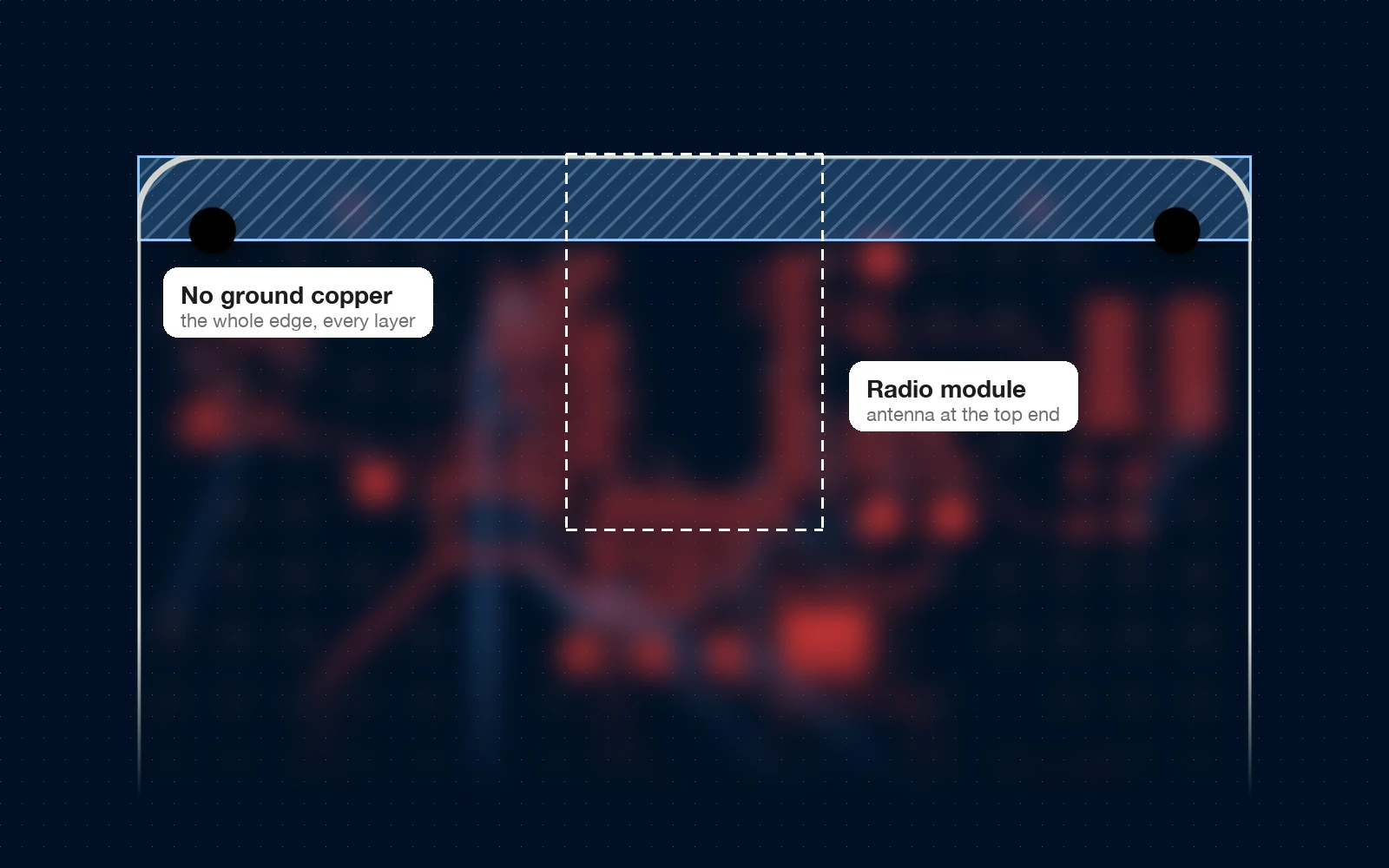
Patch sends its readings to a phone over Bluetooth, through a small radio module with its antenna built in at one end. A module like that arrives already designed and tested by its maker, which saves a great deal of work, but only if the board around it follows the maker’s rules. The most important rule is about what is not there.
An antenna needs empty space
An antenna works by sending energy out into the space around it. Copper nearby, especially a large sheet of it like the ground layers inside a circuit board, pulls that energy back and detunes the antenna. So the maker asks for a band along the board’s edge, at the antenna end, with no ground copper in it: not on the top, not on the bottom, not on any layer in between. It asks for that band to run across the whole width of the board, not just the width of the module, with ground connections stitched around the module’s corners.
On a small board, that band is expensive. It is board area that can carry nothing, at one edge, for the sake of one part.
Caught on review
Our development board first had the empty band only across the module itself. It passed our own checks, because our checks matched what we had drawn. An independent review compared the board with the module maker’s datasheet and pointed out that the band should run the whole width. We widened it across the full edge, on every layer. The cost was small: a handful of ground connections moved out of the way, and nothing else had to change. (Why we lean on reviews and planted mistakes: every check has to catch one.)
The body is in the way
A phone in a pocket and a patch on an arm share a problem in different sizes: the body is mostly water, and water soaks up radio energy. For Patch the body is not just nearby, it is a few millimetres under the antenna. We modelled how much that matters. The model is simple and only a rough guide that close to the skin, but its message was clear: how far the antenna sits from the body matters far more than which way the module faces. Every orientation we tried came out about the same. The distance did not.
That shapes the plan. The plan keeps the radio at a low transmit power, which the model says still leaves plenty of margin at the distances a phone is usually kept. The module’s exact placement and orientation are still under review with its maker, who has our design files.
Measured, in the end
A model that is unsure near the skin is a reason to measure, not to guess. A planned bench test reads the signal from a patch on an arm, with the phone in front of the body, beside it and behind it, at the distances phones actually sit. Until then, the empty band is the part we can get right on paper, and the development board has it.